A very troubling recent find in our ocean was a huge ‘island’ of trash twice the size of Texas and more than 30 feet deep. Just imagine a 3 story Wal-Mart sprawling from the Mexico border up from California and Arizona, through Nevada, Idaho and the whole west coast (including Oregon and Washington) and you have and idea what I’m talking about. The overall area of this behemoth is twice that of the Continental United States given its depth. Now imagine that there are TWO of them: the Western Garbage Patch just north of Hawaii, and the Eastern Garbage Patch just east of Japan.
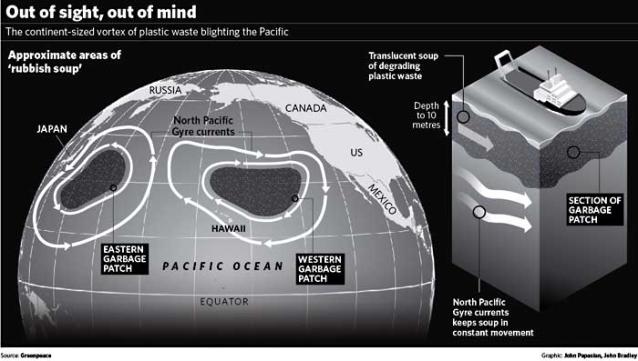
I can’t say it was that recent, as it was predicted by NOAA (National Oceanic and Atmospheric Administration) back in 1988 and has been tracked (and growing) ever since. So why has it taken so long to get out to the public and why are there still people who don’t believe in its existence?
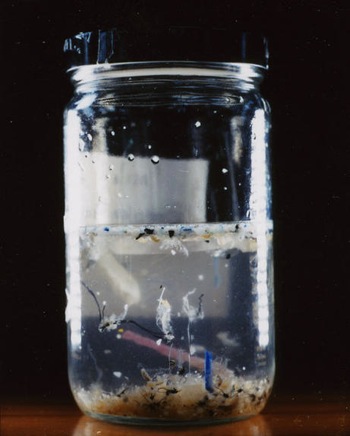 I keep putting ‘island’ in single quotes because it’s not quite what you may imagine, instead of a big mass of floating plastic bottles and trash, it’s actually more like a plastic soup, constantly moving just below the surface of the water. This is why there are no real pictures of the island and you can’t see it on Google Earth, or in satellite images. Without pictures of a so called ‘trash island‘, people are less likely to believe in its existence and the media has no stimulating images or graphics to catch our attention with.
Additionally, the plastics have been affected with photodegradation, which causes the plastic to break down into smaller pieces (while still remaining a polymer) and are ingested by smaller and smaller animals throughout the food chain. This allows the plastic to penetrate the entire food chain from the bottom up.
As an example, say some plankton (very small animals at the bottom of the food chain) eat some of this plastic. Then, a hundred of these plankton are then eaten by a small fish, like a Sardine. Then a Mackerel eats 25 of these Sardines. Then a Tuna eats 10 of these Mackerels. Then you eat a Tuna. Well guess what, you just ate a bunch of plastic, just how much? 100 (plankton) x 25 (Sardines) x 10 (Mackerels) = 25,000 pieces! Through a process called bioaccumulation, the amount of a substance is concentrated as it is passed up through the food chain to the top predator, scary huh?
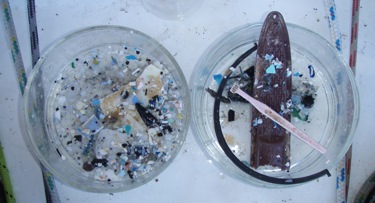
Plastic pulled up from the Pacific Gyre by Algalita Marine Research Foundation
A five-year survey of Fulmars found in the North Sea region found that 95 percent of these seabirds contained plastic in their stomachs. Studies of the Northeast Atlantic plankton have found plastic in samples dating back to the 1960s, with a significant increase in abundance in time.
–United Nations Environment Program
 At this point, the best solution is to stem the cause through a reduction in waste entering our oceans, particularly plastics. I am a huge proponent of a reduction or elimination of disposable plastic bottles and plastic bags through reuse of durable goods like metal containers and canvas bags.
Several cleanup ideas have surfaced which vary from a floating recycling plant to the melding of plastic into a Utopian island. The most practical and organized appears to come from the Environmental Cleanup Coalition which proposes a large floating cleanup flotilla with an accompanying algae and tuna aquaculture operation to support costs.
Further research and updates on the Pacific trash gyre can be found on Algalita Marine Research Foundation‘s website.
Comments 55
Pingback: Thursday Link Love | Green + Chic
Pingback: Friday Sustanability Report | The Chic Ecologist
Holy crap!! I had never heard of this until today. I am shocked not only at the magnitude of this disaster but also at the fact that no one seems to care about this. What can we do to help? I would like to do my part to restore/preserve the beauty of our planet.
>> “The overall area of this behemoth is twice that of the Continental United States given its depth.”
this is nonsense. area is a 2-dimensional measurement, regardless of depth. you really cant take depth into account in this comparison, unless you want to compare its volume against a section of the earth’s crust which you arbitrarily set at 15 feet deep, and also disregard variations in continental surface (eg. mountains).
>> “Then a Mackerel eats 25 of these Sardines. Then a Tuna eats 10 of these Mackerels. Then you eat a Tuna. Well guess what, you just ate a bunch of plastic, just how much?”
well, none, because we dont eat fish stomachs. i guess at the sardine level, you’d have a point, but what you have posted could be described as liberal fear mongering.
your purpose seems to be to convince people of the existence of garbage island, but your speculative analysis only brings your evidence into question.
and dont get me wrong, i’m not some hippie-bashing conservative; i came here looking for _information_ on this topic, but i’ve only found garbage.
Author
@anon –
I appreciate your comment, however, I believe you are missing the point of the entire article, and your very first point makes me believe you failed to even read it.
The very first sentence reads: “…twice the size of Texas and more than 30 feet deep.”
In my attempt to keep the article brief and interesting, I have omitted proven scientific processes such as bio-accumulation in favor for a more simplified step-by-step.
The accumulation of plastic in the tissues of fish (that’s right, tissue- muscles, fat, etc… the stuff you eat) is no different than the way high-levels of mercury are accumulated in tuna, which is fairly common knowledge now, and can hardly be called “liberal fear mongering.”
I see that you are a person who would rather dismiss evidence that runs contrary to your beliefs than investigate further, but if you actually would like to learn more, i suggest browsing scientific journals and research papers on the subject. You can start with the NOAA and Algalita Marine Research Foundation links provided in the article.
Just as stated above, when i start eating the contents of tuna stomachs, than i might start to worry…even then, plankton is pretty much microscopic, meaning what they eat is even smaller. Also, consider the probability of each fish on the next rung up ONLY eating fish that ingested the plastic (which is a pretty improbably statistic considering the number of fish in the sea), or the odds of buying a can of tuna that happened to have eaten a contaminated fish, or just how diluted the contaminants would be due to the overwhelming number of uncontaminated fish also ingested. But even if we were to directly eat 25,000 microscopic particles of degenerated plastic, polymer and all, the fact that it’s been sitting in salt water (the chlorine in sodium chloride acts as a disinfectant much as the chlorine in a pool) really doesn’t pose much to worry about. Your gastrointestinal tract may have some difficulty, but either way, the only evidence you’re likely to find will be the undigested, microscopic specimens in the toilet bowl. i think its pretty safe to say that even if we ate the plastic directly, we still inhale, ingest and expose our skin to millions of other more deadly bacteria every single day.
Other than food supply, which has been denounced, what threat does it impose? Atmospherically only pure water evaporates, leaving all other residual contaminants behind.Environmentally, rainwater and incoming water sources from land masses are always diluting. They’ve dumped it in no-man’s land where it doesn’t have any affect on people. Contaminating a water source that’s not fit to consume in the first place? Its invisible to anyone and everyone who isn’t an oceanographer. I could be relatively ignorant and be overlooking something, but I don’t think there are really any direct, or indirect for that matter, negative influences. Think of all the trash that’s dumped on land. I’m positive the world’s trash (on land where people LIVE) could cover the continental United States MORE than twice over (assuming volumetric measurements COULD actually be translated into 2-dimensional units. You can spread ANY volume over the state of Texas if you spread it thin enough.)
We test nukes and other radioactive materials in remote, desert places in the southwest because no one is there. How is this different?
All in all, its a bunch of hype that isn’t a big deal. Life goes on. There are far worse problems the world could be tackling right now! What we don’t need is someone on the sidelines distracting the rest of the country’s concentrated effort on issues that influence Americans everyday!
Author
I am only informing you of its existence, it is up to you to do what you will with that information. Keep in mind this is my profession, and arguing this is much like arguing the existence and potential damage of cancer with a medical doctor. I doubt you will find any biologist or ecologist who would refute any of the information presented in this article.
I am not sure where you get your information about the ocean being a disinfectant, or that eating toxic compounds found within plastic is harmless, or that a compromised food supply poses no real threat. Given your logic about the plastic, then we shouldn’t worry about mercury levels in tuna either.
Of course there are more pressing ‘survival’ issues we face today, we may get hit by a bus tomorrow crossing the street, but let us not ignore the slow cancers developing on the earth. It is not you that will face the ignorance of our destructive ways, it is your children and their children that will be most affected.
I apologize for my remarks. While our perspectives regarding the issue vary, it’s clear that there is a problem. I don’t always stop to realize that your kind of profession is always out to tackle these sorts of conflicts, one way or another. Although there are more pressing issues among the human race, this is your work, your field of knowledge and maybe even your passion. Who am I to belittle the content of your writings?
It is a problem. For the welfare of the animals and the environmental health of the sea and its inhabitants; it needs attention. The affect it holds on the human race, how big or little it may be, is where I failed to recognize the relevance. Your work, as it seems, isn’t about people, but about improving the environmental states of ecosystems, regardless of the degree of influence on people. I respect that. I hope you accept my apologies!
who are these people on here?
I love the ‘information’ on here and in my opinion all the “far worse problems the world could be tackling right now,” (as alerted by previous writer) will and do pale in comparison to the massive permanent extinction of species on this planet and the other very urgent and startling environmental issues, oh…how about like a couple of new enormous continents made of mini pieces of plastic that 95% of ocean birds think is food?
who are these geeky chumps that read this information and think that their precious and fleeting life is not inherently bound to the physical and natural processes of this (barely, now) self-sustaining earth? I have this message for them: your kids wont make it past 15 and you cannot take your 300 iphone apps to the grave! (what do you have to say to that, heh?)
fu*k that i hate plastic
Pingback: One Reason the Giant Garbage Island in the Pacific Sucks - Unlikely Words - A blog of Boston, Providence, and the world
Pingback: My favorite Recycled things #2 « Gorgeous and Green
Pingback: Where do your bits of plastic go?
Author
More great information coming in. A great New York Times article with more pictures and info thanks to Lindsey Hoshaw (check out her blog of the adventure).
Thanks for the article Jean-Paul. I recently started researching this after reading an article linked from ‘no impact mans’ website. It is purely amazing to me how much waste is dumped into our oceans everyday and more amazing how its all finding its way back to us. We must protect our ecosystem so that our future generations will be able to enjoy life in a better state of being. Thanks again.
Pingback: Safest Reusable Water Bottle Choice BPA Free | The Chic Ecologist
Pingback: Reusable Shopping Bag Choices | The Chic Ecologist
Pingback: Say no to plastic or yes to recycling it. « Adventures Under the Umbrella
Pingback: Design Within Reach Eco Design Water Filter | The Chic Ecologist
Pingback: Chris Jordan - Message from Midway | The Chic Ecologist
Pingback: Worlds Largest Solar Powered Yacht | The Chic Ecologist
Pingback: Suffocated By Plastic « J500 Media and the Environment
Pingback: Refillable Whiteboard Markers - Auspen | The Chic Ecologist
WOW!!!
im really supprised NO ONE cares!! about this.
F.Y.I if you see trash pick it up no matter where you are….
If you want to save your planet then… It just starts by a little step at a time. If you want to save are planet then pass the word around and maybe the goverment will get a clue
PEOPLE ARE STUPID
see in the old days people just took what the needed
and now we have overfishing…
and pollution
and if you get the chance look up ” the plastic island”
GO GREEN AND GO BLUE
AND SAVE OWER PLANET!!
Unbelievable!! i can’t get the image out of my head. i’m sick by what i seen.
Thank you for this information, I will pass the link on to everyone I can get to listen. What a deeply disturbing issue, and I am shocked here we are in 2010, and I am just now hearing about this.
trash island was made by the government
where are the pictures of this big pill of texas
Pingback: Green Twitter People to Follow | The Chic Ecologist
made by the govt yo and there to lazy to go clean it up
The accumulation of plastic in the tissues of fish (that’s right, tissue- muscles, fat, etc… the stuff you eat) is no different than the way high-levels of mercury are accumulated in tuna, which is fairly common knowledge now, and can hardly be called “liberal fear mongering.”
Bioacumulation? Think. There is a lot of alarmist pseudoscience here. Most of indigestibles, inclusive of plastic is expelled from the organism, everytime it shit. Even protozoan “shit.”
Author
MOST does not equal ALL, hence the ‘accumulation’ in bio-accumulation. If what you are saying is true, then we would have no problem eating cyanide or mercury straight. Just because something isn’t a commonly digested item, doesn’t mean our body wont absorb some of it. It doesn’t take much as just eating off of lead plates was enough to kill people earlier in history.
Pingback: Top 2010 Green Articles | The Chic Ecologist
Im really loving this website, and hope this, along with the excellent article some other individuals have written, will help people
This island is NOT AN ISLAND! First off, there is no surface matter to it, so calling it an island is inaccurate and shows you are only making a statement that is false to get attention to a problem. However, when you use deceptive terms like island for something that is not above water and is not a solid mass you can walk on, you do more harm to your cause than good. Yes, this is a scary problem but such ignorance and blatant disregard for the intelligence of people makes people far less likely to believe you and disguises the real problem here. Also, if it is as big as is claimed, it would also not be an island, it would be a continent. Once you master the english language and the proper use of words to describe a problem, it would greatly help you get your message across.
If you want people to understand and believe you, call this a debris field, which is exactly what it is.
@Mergathal
Who CARES what is is CALLED? It does not make a difference! It doesn’t mean that is not there.
Besides in your comment you called it an island.
The problem I have with it is that the “Island” is in fact just a theory. If there were such a thing we would have some image of it, there is none because it probably does not exsist. It is in fact a theory with very loose research behind it.
Author
@James – Actually, it is not a theory and they do have pictures of it. As Mergarthal points out, it in fact is not an island, but a mass collection of plastic debris and ‘goop’ laying just below the surface, so the pictures look more like a jar of ooze with bits and pieces in it. This ‘loose’ research, if you had read the article, was discovered, verified and studied by NOAA, as well as several high standing scientific and educational institutions not to mention all of the non-profit and environmental groups. It does exist and several expeditions have proven this fact. In addition, the science behind it has lead to the discovery of 2 more ‘plastic islands’, one in the Atlantic, and one in Asia.
@Mergarthal – You are correct, and scientists do not call it an ‘island’ but they are attempting to put it into words that the world can understand and visualize. While it is not an ‘island’ you can go out and walk on, it is a huge collection of debris laying just below the surface, but that doesn’t fit on most press memos.
wow! all of you that think this is not a prob is wrong this is i big prob and should be dealed think with!currently i am doing a report on the subject and i agree that this is just as big a prob as the golf of Mexico was all of it is polluting the earth that we depend on
Good intentions don’t excuse bad math.
An area cannot be compared to a volume. If we sliced a centimeter at a time from the volume of the floating “island” than you could just as easily say that its area is larger than the Earth itself. It simply does not make sense to say it is twice as large as the US unless you are assuming the US to be significantly less than 15 feet deep.
We can all learn from each other and you have done some respectable research. But when someone offers you a technical correction and you spout out a bunch of alarmist rhetoric, you are just as closed-minded and ignorant as anyone you are castigating. The world’s problems cannot be solved until we learn to listen and value being correct in what we say.
Author
@Jay,
An area can easily be compared to a volume, it is a height x width x depth, no different than a piece of furniture occupies 3 dimensions. I am speaking of a confined area by comparing it to a recognizable feature. If I was to say that it encompasses a volume of xx cubic miles, I doubt all but a slim number of readers would know spatially what that looks like.
This is really a description of the affected area, but to get specific, given the density and average particle size, if you were to strain all the pieces out and lay them flat to create a solid surface, it would easily measure twice the size of the continental US or larger.
There is no ‘alarmist rhetoric’ here, only a practical illustration that is based on scientific research. If everything was described to a scientific specification, in scientific terms no one would understand anything except for the scientists themselves, and we already know what is going on.
Pingback: Pacific Plastic Trash Island
Pingback: California Moves to Ban Styrofoam State-Wide
WOW,
I cant beleive the idiocy of the people willing to leave comments here. My favorite is James Dagg “….If there were such a thing we would have some image of it, there is none because it probably does not exsist. It is in fact a theory with very loose research behind it.”
I wonder how you feel about gravity. Is it real? you cant see it but people keep saying its what keeps you stuck to the ground. I bet your religious, can you see any proof of divinity or do you just blindly follow? The FACT of this matter is that Plastics don’t break down. they are an unnatural creation of man that are having adverse effects on the food chain, causing reproductive problems in HUMANS around the world. the idea that we are infallible in our creations is preposterous. as a species we find a solution to make our lives easyer without researching its effects on the environment we are stuck in.
I think the biggest problem we have is that critical thinking is a forgotten part of our society as a whole.
Pingback: The difference between Biodegradable and Compostable | Swipes Lovin Wipes
Pingback: Who Wants some Plastic Soup? « NJ Surfrider: Posts for Kate
Pingback: Who Wants some Plastic Soup? | Reviews of Surfrider Bolgs
It should be noted that the image of the globe provided by Greenpeace is an inaccurate representation of both the garbage patch and the Pacific Ocean currents. The North Pacific Gyre is a single massive current system (not two as on the Greenpeace globe) that circles the north Pacific Ocean, in which THE garbage patch (not two as shown on the Greenpeace globe) accumulates. Greenpeace’s image is not accurate to real oceanography.
Author
@L – Yes, it is a simplification of what is going on. Generally, the more technical one gets, the less people can understand what is going on. There are several journals depicting actual gyre and current behavior and garbage patch locations.
For a better understanding with varying degrees of technicality, the NOAA website is a great unbiased and verifiable resource.
Pingback: Erin School Student Council Chooses Green! | Student Council Blog
Pingback: Plastic or? - CAVDESIGN
Pingback: [Infographic] Mother Earth, Finally Suffocated to Death!
Pingback: Traveling To Bamboo Village - Part 1 | The Chic Ecologist