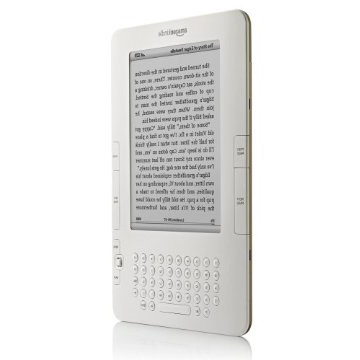
 So the question on every green minded book fanatic, is the Amazon Kindle green? In short, yes, if you use it enough. The estimation, provided by the journal of Environmental Science and Technology, is that you can save approximately one tree per year if you replace your daily newspaper with the e-version.
That accounts for a 700 pound reduction in paper use just from the daily newspaper, add in another one or two pounds for each book and you are looking at quite a big tree.
Lets not forget that trees aren’t the only thing you are saving. Think of the energy expended in the manufacturing, production, transportation of paper goods, printing, chemicals and fossil fuels used in that process. A similar study by the same journal found that 67 times more water is consumed and 140 times more of the green house gas Carbon Dioxide (CO2) is emitted by printed newspaper over the electronic version. Books use even more water (up to 78 times more) than e-books.
While the end benefit of a book is that it lasts a very long time with care, is quite sustainable and is completely biodegradable, the Kindle isn’t all bad. With additional batteries available for individual purchase (just in case your battery dies, you can replace it instead of discarding the whole unit), and end of life recycling provided by Amazon, it doesn’t have to stick around in a landfill and pollute.
Overall, if you subscribe to a daily print paper and read several books a year, the Kindle is something you should definitely consider if you care about your carbon footprint.
Comments 17
Comics….are they on kindle?
oh, i hope the 3 trees i save in the 3 years before this becomes outdated hardware (that’s being generous) will outweigh the however many years it will take for this thing to sit in a landfill and degrade and seep into the ground.
Kindle as green technology… Yep, sounds like BS to me. Especially when my books stay on my shelves for 50 years and my newspapers are 100 percent recyclable. This is marketing baloney…
Pingback: iTunes, Kindle, NetFlix…Green Distribution | Driving Change - The Green Car Company Blog
Are you factoring in the manufacturing costs of the Kindle? Sounds like you’re not. Is the Kindle itself recycled/recyclable, or does it end up in a toxic waste dump in China? What about the batteries it takes to read on it? You’re using power every time you turn it on–not so with a paper book/newspaper.
Libraries are surprisingly green in the sense that the resources are shared by many individuals as opposed to bookstores where print publications are manufactured and the end-product is likely to be read once and subsequently left to gather dust on a shelf.
Paper is recyclable. Forests are renewable resources. There is a carbon footprint to newspapers and books, true, but so too is there a carbon footprint to the manufacture of electronic gadgets, such as Kindle.
In my opinion, the Green aspects of Kindle are overrated. Ultimately, a Kindle reader or its ilk will have to be sold to every student, every recreational reader and used often. By contrast, a library book is sold to several hundred institutions and shared by many. As odd as it is to consider, libraries are greener in the sense that the resources are few but the use is many.
Kindle devices, like other gadgets, are constructed of the same petro-chemicals that are heralded as so wasteful in plastic drinking bottles. Inside that device is a battery containing highly toxic ingredients, which doesn’t even begin to take into account that the device has to be recharged until the product wears out or becomes obsolete. A book, by contrast, never requires another ounce of drawdown on the electric (coal powered) grid once it has left the publisher’s warehouse. A print publication does not contain toxic parts, and it is even possible to use biodegradable, soy-based inks. A conventional book, magazine or newspaper will not end up in a Third World electronic scrap yard where children pick over the parts in search of something to resell. Books are not carcinogenic, whereas the components in many of our circuit boards are, not to mention the IQ diminishing effects of the lead content. A small child could rip up a newspaper and shove it into his or her mouth and you won’t have to call poison control. It ought to tell you something about how “green” a gadget is when you know that the innards of the device would be very, very harmful if ingested. Do you know, for example, that you are supposed to wash your hands after handling a batter, even a button cell that is designated for your watch? That is because these things are toxic. And that doesn’t even begin to account for the circuitry inside the device itself.
I think we forget that carbon footprints don’t constitute the entire environmental equation. We have to ask whether what we are consuming is biodegradable. We have to consider whether a company will have to sell several billion widgets to equip every school child or reader around the world vs. 6 million copies of a book that will be shared, library style, by many individuals.
Paper production has its environmental costs but by in large that ends when the product is complete. For many of our electronic gadgets, the life of the product has only just begun when it lands on a store shelf. From the point you buy the product onward, it will rely on our overtaxed electric grids, and it will eventually be replaced, upgraded and discarded just as inexpensively and frequently as some people replace and upgrade their cell phones. Remember back when each household had one land line and the production of telephones was limited to pay phones, business environments and a single line into a single-family household? Now we have a huge carbon footprint just associated with cell phones alone, not to mention the toxic by products and the petro-chemical drain of all those plastics. The consume-and-discard mentality is what keeps the American economy afloat, but the challenge of going Green is too use everything more wisely, which is to say buy less, share more, and opt for nontoxic and biodegradable options whenever possible.
We need to round out our view of what “Green” really means. To conceptualize Green merely in terms of a carbon footprint is convenient, but ultimately dangerous.
Pingback: GreenSmart vs. GreenDumb « The Social Critic’s Guide to Life, Faith, Politics & Media
Author
@NewsView:
I agree whole heatedly with your argument against electronics, and I appreciate your comment, I do believe that both sides should be investigated.
The creation of a book is far from a ‘green’ process in itself:
“over 28,000 gallons of water are used (mostly in bleaching) to produce one ton of paper. When this water is released, it can only be treated so well, and many contaminants are released into the environment” –epa report on paper mills
It begins with logging, some which is less damaging than others (managed vs. clear-cut), but both require tremendous amounts of energy (usually in the form of diesel fuel) to cut and transport the logs.
Then there are Paper mills, which have devastating effects on aquatic life, flooding rivers and streams with toxins such as Dioxide, Chlorine, Sulfuric/Sulfurous Acid, Ammonia, Lead, Cyanide and more (ask anyone who has lived near a paper mill, its quite noxious).
Then it moves to printing, where the majority of printers use petrochemical solvents as a base to the ink. The books undergo a binding process (more chemicals, toxic glues, etc).
Next its distribution. All of these incredibly heavy materials must be shipped all over the world, and in the case of newspapers and some periodicals, this happens on a daily basis.
That being said, it’s really a lose-lose situation, but in some cases electronic items, such as the kindle, are more green than it’s hard copy cousin the book.
Pingback: Analfabetismo Digitale « Almanacco Americano
What are the environmental impacts of manufacturing the Kindle? There is a lot of tech in a Kindle, so there has to be some negative to it, right? These are manufactured in Asia, so overall, is the Kindle still “green”? What is the total usage to cover the “environmental impact” of its manufacturing process?
Pingback: Green nPower Personal Energy Generator | The Chic Ecologist
Well, I don’t know if the Kindle is green or not, but I do know that my blog is available on the Kindle, and I lead a VERY green lifestyle… My border collie and I are building an off the grid green home in the middle of nowhere… http://www.hermitblog.com
Thanks for the article!
Its all about money, publishers and retailers make more money when the book or magazine is in an electronic format. Electronic books and magazines have their advantages, but they do more harm to the environment then printed books. Around 10%-30% greater impact. “M Enroth, Environmental impact of printed and electronic teaching aids. Vol 36 2009” And paper comes from a renewable resource – Trees.
Every day the paper and forest products industry plants more than three times the number of trees than are harvested — paper is truly renewable and sustainable.
Electronic devices are typically made of plastics and other non-renewable resources and often contain chemicals and metals.
Basically agree with everybody here. The kindle is still pretty gimmicky and is not the last reading thingy you will ever have to buy. I am sure every couple of years you will have to upgrade, just like computers.
1. Electronic products are not exactly things you could put in your compost heap. But it would be nice to browse periodicals without having to subscribe to all of them. My reading room pretty much has an inner fort of newspapers in it as we speak.
2. Those “earth friendly (not)” batteries will need to be replaced every few years
3. And nobody mentions that looking at an electronic screen at close distance is HARDER on your eyes than a book. I mean come on people. When is the last time reading an actual book made your eyes sore. Books are far safer for your health on that aspect alone.
(You can argue that the text size on books is small and the kindle has text size adjustment feature so kindle wins that argument.)
When they can cook up a device that has a reading technology that does not involve radiation of any kind then we will be there. But not yet and probably not for a while.
Pingback: Quora
I personally think the kindle is great and it saves trees. With its eink we use less paper killing off less trees and if we don’t need the kindle any more we can pass it on to future generations.
I read all my books (many each year) in kindle for iphone and ipad. I do not have the Kindl itself. And I am sure I saved some trees already.